


The GES-C01 exam charges full price for every attempt, which makes choosing well the first time a financial decision too. The Snowflake SnowPro® Specialty: Gen AI Certification practice questions from ITExamDownload are how careful candidates avoid paying twice.
Snowflake GES-C01 Exam Syllabus Topics:
| Section | Weight | Objectives |
|---|---|---|
| Topic 1: Snowflake for Gen AI Overview | 26% | - Snowflake Copilot and AI assistant capabilities - Role-based access control (RBAC) for AI resources - Cortex AI components: Cortex Search, Cortex Analyst, Cortex LLMs - Snowflake Gen AI principles and best practices |
| Topic 2: Snowflake Gen AI Governance | 22% | - AI governance framework and policies - Cost management and token-based pricing - Monitoring, logging, and observability - Guardrails, safety controls, and bias mitigation - Audit and compliance for AI workloads |
| Topic 3: Snowflake Gen AI & LLM Functions | 40% | - RAG implementation in Snowflake - API integration and authentication - Cortex LLM functions: COMPLETE, CLASSIFY_TEXT, EXTRACT_ANSWER, SENTIMENT, SUMMARIZE, TRANSLATE - Embedding functions: EMBED_TEXT_*, vector storage and similarity search - Model deployment with Snowpark Container Services and Model Registry |
| Topic 4: Snowflake Document AI | 12% | - Document AI setup and configuration - Performance optimization and troubleshooting - Document preparation and processing - Data extraction and structured output |
Snowflake GES-C01 Exam: Your Questions, Straight Answers
Snowflake SnowPro® Specialty: Gen AI Certification is an official Snowflake exam, catalogued under the code GES-C01. Passing it earns you the SnowPro® Specialty: Gen AI certification at the Specialty level. It also connects with SnowPro Core, SnowPro Associate: Platform. The credential carries the vendor's authority, which is why it keeps opening doors for the people who hold it.
Yes, and for every version. ITExamDownload provides free demos of the Snowflake SnowPro® Specialty: Gen AI Certification material so you can compare the PDF, SOFT, and online formats before deciding. After purchase, updates are free for 365 days, and when your product expires you can extend the update service at a 50% discount.
Snowflake SnowPro® Specialty: Gen AI Certification gives you 55 questions inside 85 minutes. Rather than cramming mechanically, rehearse the pace actively: the ITExamDownload SOFT engine teaches through timed exercises, so flagging, skipping, and returning become reflexes before exam day rather than improvisations during it.
Passing Snowflake SnowPro® Specialty: Gen AI Certification requires 750 (scaled 0–1000), and official registration costs $225 USD. Since every retake bills the full $225 USD again, the sensible sequence is practice first, book second. When your ITExamDownload practice scores clear the requirement across repeated sessions, the exam stops being a gamble.
Active SnowPro Core or SnowPro Associate: Platform certification; 1+ year Gen AI experience with Snowflake; proficiency in SQL, Python and data engineering concepts
Vendor rules change over time, so confirm the current conditions before registering on the official exam page.
Registration for Snowflake SnowPro® Specialty: Gen AI Certification is handled through the official channels below.
When scheduling, note that the exam is delivered Online proctored (OnVUE) or onsite at Pearson VUE test centers.
Snowflake recommends the following training for Snowflake SnowPro® Specialty: Gen AI Certification candidates.
Pair any training with the 351 practice questions in the ITExamDownload GES-C01 package; active exercise is what makes learned material retrievable under exam pressure.
A 100% money-back guarantee covers you under stated conditions. Take the Snowflake SnowPro® Specialty: Gen AI Certification exam within 60 days of purchase; if you fail, you may claim a full refund, provided the exam matches your product. Attempts within 3 days of purchase are ineligible, as are downloaded-but-unused products, free materials, and expired orders; the candidate name must match the payer name. Submit a scanned enrollment slip and the official Score Report PDF within 2 days of the exam, and claims are processed within 7 days. You may instead exchange for two other exam products of equal value, free, keeping the update service on your original purchase.
Delivery is safe and fast: payment runs through a secure environment, files unlock for download at once, and everything is emailed to you within one minute. If nothing arrives within 2 hours, check spam and consult our online service. Installation is unlimited across your computers.
Snowflake SnowPro® Specialty: Gen AI Certification is divided into 4 official domains, led by Snowflake Gen AI & LLM Functions (40%), Snowflake Document AI (12%), and Snowflake Gen AI Governance (22%). The complete breakdown is above on this page; candidates who study the syllabus first waste the least time later.
Snowflake SnowPro® Specialty: Gen AI Certification Sample Questions:
A data application developer is tasked with building a multi-turn conversational AI application using Streamlit in Snowflake (SiS) that leverages the COMPLETE (SNOWFLAKE. CORTEX) LLM function. To ensure the conversation flows naturally and the LLM maintains context from previous interactions, which of the following is the most appropriate method for handling and passing the conversation history?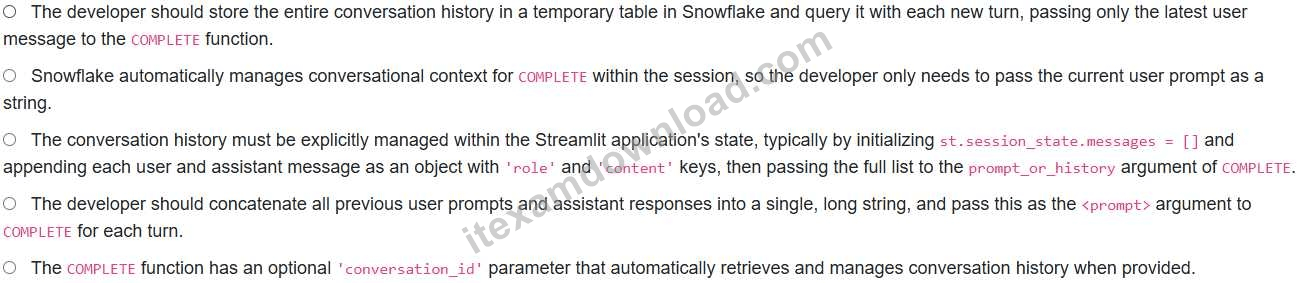
- A. Option E
- B. Option D
- C. Option B
- D. Option C
- E. Option A
Correct Answer: D 🗳️
Explanation: Only visible for ITExamDownload members. You can sign-up / login (it's free).
A data engineering team is deploying Snowflake Cortex Analyst to enable natural language queries over their structured SALES_DATA table, which includes columns like PRODUCT_CATEGORY, SALES_AMOUNT, and ORDER_DATE. To maximize the accuracy and trustworthiness of responses for business users, which of the following practices should the team implement when configuring their semantic model?
- A. Option E
- B. Option D
- C. Option B
- D. Option C
- E. Option A
Correct Answer: A,E 🗳️
Explanation: Only visible for ITExamDownload members. You can sign-up / login (it's free).
An ML engineering team is preparing to log a custom Python model to the Snowflake Model Registry. This model has several Python package dependencies. The team wants to ensure the model can be deployed optimally, either in a Snowflake warehouse or to Snowpark Container Services (SPCS), depending on future needs. They are particularly concerned with how dependency specification impacts deployment eligibility. Which statements accurately describe how Snowflake handles model dependencies and determines deployment eligibility for custom Python models logged in the Model Registry, particularly when considering both Snowflake warehouse and Snowpark Container Services (SPCS) environments? (Select all that apply.)
- A. For models intended for SPCS, 'pip_requirements' are always preferred over 'conda_dependencies' because SPCS strictly prohibits the use of any conda packages from 'conda-forge'
- B. When 'conda_dependencies' are specified for a model to be deployed to SPCS, these dependencies are by default obtained from 'conda-forge' rather than the Snowflake conda channel.
- C. If all of a model's 'conda_dependencieS are available in the Snowflake conda channel, the model is automatically deemed eligible to run in a warehouse.
- D. The function will fail if 'WAREHOUSE is specified in 'target_platforms' but the model's size or GPU requirements make it ineligible for warehouse deployment.
- E. Specifying both 'conda_dependencies' and 'pip_requirements' for a model is recommended to cover all possible deployment scenarios, and Snowflake's build process ensures compatibility between them.
Correct Answer: B,C,D 🗳️
Explanation: Only visible for ITExamDownload members. You can sign-up / login (it's free).
A development team is building an AI-powered data pipeline in Snowflake. The pipeline involves extracting text from documents, generating embeddings using
,and then performing similarity searches using
to find related documents. They plan to manage this pipeline using Snowflake tasks and want to integrate with a Python application for some custom processing. Considering this scenario, which of the following statements about implementing this pipeline are true?
- A. When using Snowflake tasks to automate the embedding generation and similarity search,
- B. If the team wants to use the Snowpark Python library to call

- C.

- D. Snowflake
- E. To generate document embeddings, the
Correct Answer: C 🗳️
Explanation: Only visible for ITExamDownload members. You can sign-up / login (it's free).

- A.

- B.

- C.

- D.

- E.

Correct Answer: E 🗳️
Explanation: Only visible for ITExamDownload members. You can sign-up / login (it's free).
Viewing page 1 out of 71 pages.
Viewing questions 1-5 out of 351 questions.
 Monroe

 Elma
 Sherry
 Martha

 Dempsey
 Robin
 Maggie

 Greg
 Beau
 Tiffany
 Herbert
 Charles
 Kennedy
 Jay


