


Confidence before an exam does not come from promises; it comes from repetition. That is the idea behind the Microsoft Identity and Access Administrator materials at ITExamDownload: 398+ Q&As covering the Microsoft Identity and Access Administrator objectives, expert-verified answers, and a free demo so you can start building that repetition today, in 2026, without any upfront cost.
Microsoft SC-300 Exam Syllabus Topics:
| Section | Weight | Objectives |
|---|---|---|
| Topic 1: Implement an authentication and access management solution | 25-30% | - Manage user authentication
|
| Topic 2: Plan and implement an identity governance strategy | 25-30% | - Plan and implement privileged access
|
| Topic 3: Implement access management for apps | 15-20% | - Configure Azure AD Application Proxy
|
| Topic 4: Implement an identity management solution | 25-30% | - Implement and manage external identities
|
Your Questions About the Microsoft Identity and Access Administrator Exam, Answered
The SC-300 exam is the required test for earning the Microsoft Identity and Access Administrator certification from Microsoft. It assesses your command of the official exam objectives through scenario-based and knowledge questions, and the resulting credential is widely recognized by employers. Its reputation for difficulty is real but manageable — candidates who practice consistently with quality materials routinely walk in well prepared.
The official outline for the SC-300 exam highlights these domains:
- Implement an identity management solution (25-30%)
- Implement access management for apps (15-20%)
- Implement an authentication and access management solution (25-30%)
Seeing the topics laid out this way often shrinks the exam's intimidation factor — each domain is a finite, learnable block, and the Microsoft Identity and Access Administrator practice questions at ITExamDownload follow the same structure.
Candidates should have a strong understanding of authentication, authorization, and identity concepts. Experience with Azure Active Directory, Windows and Linux administration, networking, and security is recommended. Knowledge of Microsoft 365 workloads is beneficial.
The SC-300 exam is demanding, but its difficulty is specific, not mysterious: unfamiliar question formats, time pressure, and a few heavily weighted domains. All three respond to the same remedy — repeated, timed exposure to exam-style questions. That is what the Microsoft Identity and Access Administrator practice materials at ITExamDownload provide, and the free demo lets you measure the real difficulty yourself before committing, which is usually the moment the fear starts shrinking.
The SC-300 exam consists of 40-60 questions with a time allowance of 120 minutes minutes. Practicing full sets under a similar time cap is the most direct way to make sure pacing never costs you points on exam day.
Because seeing beats guessing. The free demo of the SC-300 exam materials at ITExamDownload contains genuine samples from the full Microsoft Identity and Access Administrator question set — same format, same expert-verified answers — and downloading it costs nothing. If you are unsure whether the materials match your level or your study style, the demo answers that question with evidence rather than marketing, and every demo on the site is free of charge.
The passing score is 700 and the exam fee is $165 USD. Knowing both numbers early helps you plan: aim to be consistently above the passing mark in timed practice sessions before you spend the fee on a booking.
Microsoft Identity and Access Administrator Sample Questions:
You need to meet the technical requirements for the probability that user identities were compromised.
What should the users do first, and what should you configure? To answer, select the appropriate options in the answer area.
NOTE: Each correct selection is worth one point.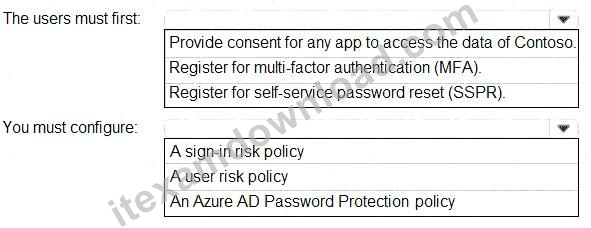
Correct Answer:
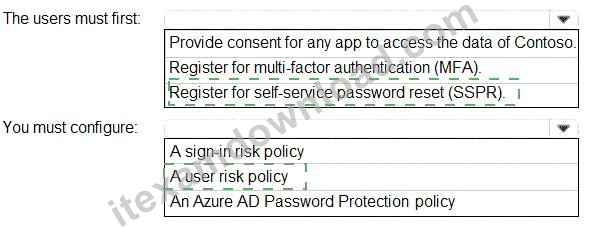
Explanation:
According to the Microsoft Identity and Access Administrator (SC-300) official study guide and Microsoft Learn module "Implement and manage user risk policies", the scenario where "users must be forced to change their password if there is a probability that their identity was compromised" directly maps to the Azure AD Identity Protection "User risk policy." In Azure AD Identity Protection, user risk represents the likelihood that an account's credentials have been compromised. When Azure AD detects a high user risk (for example, leaked credentials, atypical sign-in behavior, or sign-ins from unfamiliar locations), the User Risk Policy can be configured to automatically block access or require the user to reset their password upon the next sign-in.
Before a user can reset their password or complete remediation, they must have a registered authentication method (for password reset and MFA). Therefore, users must first register for multi-factor authentication (MFA) - this registration enables the authentication methods (like phone number or authenticator app) that are also used during password reset verification.
The SC-300 documentation specifically highlights:
"To enforce a password change when a user's identity risk is high, the user must be registered for MFA, and a user risk policy must be configured to require password change." Thus, the correct configuration is:
Users must first register for MFA - to ensure they have verified methods available.
Configure a user risk policy - to automatically trigger password reset upon detection of compromised credentials.
Correct Answers:
Users must first: Register for multi-factor authentication (MFA).
You must configure: A user risk policy.
You have an Azure subscription named Sub1.
You purchase a Microsoft Entra Permissions Management license.
You need to onboard Permissions Management.
Which two actions should you perform? Each correct answer presents part of the solution.
NOTE; Each correct selection is worth one point.
- A. From the Microsoft Entra admin center, configure the Diagnostic settings.
- B. From the Microsoft Entra admin center, create an app registration.
- C. Create a role assignment for Sub1.
- D. From the Azure portal, create a data collection rule (DCR).
- E. Implement a Microsoft Entra application proxy.
- F. From Microsoft Entra Permissions Management, configure data collection.
Correct Answer: C,F 🗳️
Explanation: Only visible for ITExamDownload members. You can sign-up / login (it's free).
You have an Azure Active Directory (Azure AD) tenant that contains the users shown in the following table.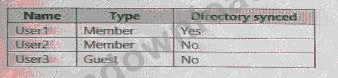
For which users can you configure the Job title property and the Usage location property in Azure AD? To answer, select the appropriate options in the answer area.
NOTE: Each correct selection is worth one point.
Correct Answer:

Explanation:
< Job title property: # User2 only
Usage location property: # User2 and User3 only
According to the Microsoft SC-300: Microsoft Identity and Access Administrator Study Guide and Microsoft Learn documentation on Azure Active Directory user management, the ability to modify user attributes such as Job title and Usage location depends on whether the user is:
Directory-synced (from on-premises Active Directory), or
Cloud-only (created directly in Azure AD), or
Guest (external B2B user)
Here's the explanation for each scenario based on the user table provided:
Name
Type
Directory Synced
User1
Member
Yes
User2
Member
No
User3
Guest
No
The Job title attribute is read-only for users synchronized from on-premises Active Directory.For directory- synced users like User1, the attribute must be managed in on-premises AD and synchronized via Azure AD Connect.
For cloud-only users (like User2) and guest users (like User3), the attribute can be modified in Azure AD.
However, Microsoft restricts certain profile fields, including Job title, for guest users unless they are given specific permissions.
# Therefore, only User2 (a cloud-only member) can have the Job title property configured directly in Azure AD.
The Usage location property determines licensing restrictions (for example, Microsoft 365 services available by country).
This property is editable for cloud-only users (User2) and guest users (User3).
For directory-synced users (User1), the value is controlled from on-premises AD, and cannot be modified in Azure AD.
# Therefore, User2 and User3 can have the Usage location property configured in Azure AD.
Job title property: User2 only
Usage location property: User2 and User3 only
Reference (Microsoft Official Documentation Extracts):
"For synchronized users, attribute values such as Job title and Department are managed in the on-premises Active Directory and cannot be edited in Azure AD."
"Usage location must be specified in Azure AD for cloud-only and guest users to assign licenses correctly."
You have a Microsoft Entra tenant.
You need to configure continuous access evaluation for app sign-ins and assign the configuration to users that are assigned the Application Administrator role.
What should you configure?
- A. a sign-in risk policy
- B. a Conditional Access policy
- C. an access review
- D. the Admin consent settings
Correct Answer: B 🗳️
Explanation: Only visible for ITExamDownload members. You can sign-up / login (it's free).
You have an Azure Active Directory (Azure AD) tenant.
You configure self-service password reset (SSPR) by using the following settings:
* Require users to register when signing in: Yes
* Number of methods required to reset: 1
What is a valid authentication method available to users?
- A. mobile app notification
- B. home prions
- C. a mobile app code
- D. an email to an address in your organization
Correct Answer: A 🗳️
Explanation: Only visible for ITExamDownload members. You can sign-up / login (it's free).
Viewing page 1 out of 80 pages.
Viewing questions 1-5 out of 398 questions.
 Janet

 Baldwin
 Mark

 Arabela

 Theresa
 Aubrey
 Monroe
 Sharon
 Yvette
 Sigrid
 Florence
 Stacey
 Sophia
 Marcus
 Abigail


