

2026 New 156-215.82 Exam Questions Real CheckPoint Dumps
Course 2026 156-215.82 Test Prep Training Practice Exam Download
NEW QUESTION # 19
Which of the following is NOT a tracking option? (Select three)
- A. Full log
- B. Partial log
- C. Log
- D. Network log
Answer: A,B,D
Explanation:
The options that are not tracking options are Partial log, Network log, and Full log. Tracking options are settings that determine how the Security Gateway handles traffic that matches a rule in the security policy. The valid tracking options are Log, Detailed Log, Extended Log, Alert, Mail, SNMP trap, User Defined Alert, and None. The other options are incorrect. Log is a tracking option that records basic information about the traffic, such as source, destination, service, action, etc. Detailed Log is a tracking option that records additional information about the traffic, such as NAT details, data amount, etc. Extended Log is a tracking option that records even more information about the traffic, such as matched IPS protections, application details, etc. [Logging and Monitoring Administration Guide R80 - Check Point Software]
NEW QUESTION # 20
Can multiple administrators connect to a Security Management Server at the same time?
- A. Yes, every administrator has their own username, and works in a session that is independent of other administrators
- B. No, only one can be connected
- C. Yes, but only one has the right to write
- D. Yes, all administrators can modify a network object at the same time
Answer: A
Explanation:
Multiple administrators can connect to a Security Management Server at the same time, and each administrator has their own username and works in a session that is independent of other administrators1. This allows concurrent administration and prevents conflicts between different administrators. The other options are incorrect. Only one administrator can be connected is false. All administrators can modify a network object at the same time is false, as only one administrator can lock and edit an object at a time. Only one has the right to write is false, as all administrators have write permissions unless they are restricted by roles or permissions. Security Management Server - Check Point Software
NEW QUESTION # 21
When should you generate new licenses?
- A. Only when the license is upgraded.
- B. Before installing contract files.
- C. When the existing license expires, license is upgraded or the IP-address associated with the license changes.
- D. After a device upgrade.
Answer: C
Explanation:
You should generate new licenses when the existing license expires, the license is upgraded, or the IP address associated with the license changes. These situations invalidate the current license and require a new one to be obtained from the Check Point User Center and installed on the Security Management Server or Security Gateway.Installing contract files or upgrading devices do not affect the validity of the license12Check Point R81,Managing and Installing license via SmartUpdate
NEW QUESTION # 22
Fill in the blank: To create policy for traffic to or from a particular location, use the _____________.
- A. HTTPS inspection
- B. Mobile Access software blade
- C. Geo policy shared policy
- D. DLP shared policy
Answer: C
Explanation:
The answer is B because Geo policy shared policy is used to create policy for traffic to or from a particular location based on the source or destination country. DLP shared policy is used to prevent data loss by inspecting files and data for sensitive information. Mobile Access software blade is used to provide secure remote access to corporate resources from various devices.HTTPS inspection is used to inspect encrypted web traffic for threats and compliance4Check Point R81 Geo Policy Administration Guide, [Check Point R81 Data Loss Prevention Administration Guide], [Check Point R81 Mobile Access Administration Guide], [Check Point R81 HTTPS Inspection Administration Guide]
NEW QUESTION # 23
Which one of the following is TRUE?
- A. Ordered policy is a sub-policy within another policy
- B. Pre-R80 Gateways do not support ordered layers
- C. Inline layer can be defined as a rule action
- D. One policy can be either inline or ordered, but not both
Answer: C
Explanation:
The answer is C because inline layer can be defined as a rule action in a policy layer. Inline layer is a sub-policy that contains additional rules that are applied only if the parent rule matches. Ordered layer is a policy layer that contains rules that are applied in order, from top to bottom. One policy can be either inline or ordered, but not both.Pre-R80 Gateways do support ordered layers, but not inline layers5Check Point R81 Policy Layers and Sub-Policies, [Check Point R81 Security Gateway Administration Guide]
NEW QUESTION # 24
Which of the following technologies extracts detailed information from packets and stores that information in state tables?
- A. Packet Filtering
- B. Next-Generation Firewall
- C. INSPECT Engine
- D. Application Layer Firewall
Answer: B
Explanation:
The INSPECT Engine is a technology that extracts detailed information from packets and stores that information in state tables.It enables stateful inspection and application layer filtering12INSPECT Engine,Stateful Inspection
NEW QUESTION # 25
Where is it possible to view SmartConsole locked account?
- A. View Sessions in Gaia portal
- B. View Sessions in SmartConsole
- C. cpview in ssh
- D. Administrators list under Permissions & administrators
Answer: D
Explanation:
The correct verified answer is A. The uploaded answer key shows C, but that is not the correct administrative location for a locked SmartConsole administrator account. Check Point documentation for unlocking administrator accounts states that an administrator with Manage Administrators permission can go to the Manage & Settings view, right-click the locked administrator, and select Unlock Administrator. That points directly to the administrator list under Permissions & Administrators, not the View Sessions page. View Sessions in SmartConsole is for active or saved administrative sessions and session ownership, not primarily for unlocking an administrator account locked by login restrictions. Gaia Portal sessions are Gaia OS sessions, not SmartConsole account lock status. CPView is a monitoring/performance utility, not an administrator account unlock interface.
This is an important correction because confusing sessions with administrator-account lockout leads to wrong operational action during a real lockout incident. Reference topics: Administrator Account Management, locked administrators, Manage & Settings, Permissions and Administrators, Unlock Administrator.
NEW QUESTION # 26
You can see the following graphic: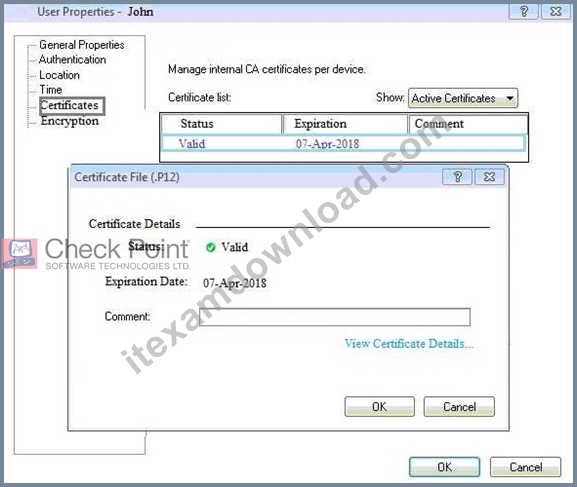
What is presented on it?
- A. Expired. p12 certificate properties for user John.
- B. Properties of personal. p12 certificate file issued for user John.
- C. VPN certificate properties of the John's gateway.
- D. Shared secret properties of John's password.
Answer: B
Explanation:
The answer is A because the graphic shows the properties of a personal .p12 certificate file issued for user John. A .p12 file is a file format that contains a user's private key and public key certificate. The graphic shows that the certificate file is valid and has an expiration date of 07-Apr-2018. The graphic also shows that the certificate file is issued by an internal CA, which is a Check Point component that manages certificates for users and gateways.Check Point R81 Certificate Management, Check Point R81 Internal CA
NEW QUESTION # 27
Stateful Inspection compiles and registers connections where?
- A. State Table
- B. State Cache
- C. Connection Cache
- D. Network Table
Answer: A
Explanation:
Stateful Inspection compiles and registers connections in the State Table. The State Table is a database that stores information about active connections and sessions on the Security Gateway. The other options are not valid names for the database that stores connection information.
NEW QUESTION # 28
What is a Security Policy?
- A. This is a written policy which has to conform with the Regulatory Compliance standards.
- B. This is stored on the Security Management Server and enforced by the log server.
- C. A collection of rules and settings that control network traffic and enforce the organization guidelines for data protection.
- D. This is stored on the Security Gateway and enforced by the Security Management Server.
Answer: C
Explanation:
The correct answer is A. In Check Point R82, a Security Policy is the rule-based configuration that controls traffic and enforces organizational security requirements, including access to resources and data protection. The official glossary describes a Security Policy as a collection of rules that control network traffic and enforce organization guidelines for data protection and access to resources with packet inspection. Option B reverses the architecture: the policy is configured and managed on the Security Management Server, then installed on Security Gateways for enforcement. The Security Management Server does not enforce production traffic. Option C describes a governance document, which may influence technical policy design, but it is not what SmartConsole calls a Security Policy.
Option D is also wrong because a Log Server stores and processes logs; it does not enforce policy. The Security Gateway is the enforcement component. In CCSA terms, this is foundational: administrators define rules, publish changes, and install the policy to gateways, where traffic is actually inspected and acted upon. Reference topics: Security Policy Management, Access Control Policy, Security Gateway enforcement, SmartConsole policy configuration.
NEW QUESTION # 29
You have been tasked with determining how much resources will be consumed by a potential HTTPS inspection deployment.
Which of the following tools can you use?
- A. Full Deployment
- B. listening mode
- C. Learning mode
- D. inbound HTTPS inspection only
Answer: C
Explanation:
The correct verified answer is B. The uploaded file marks A, but Check Point R82 documentation is clear: Learning Mode is used for partial HTTPS Inspection deployment to estimate connectivity and performance impact. In Learning Mode, the Security Gateway intercepts a small percentage of traffic to identify connectivity problems and estimate expected resource consumption for the configured HTTPS Inspection policy. "Listening mode" is not the official HTTPS Inspection resource-estimation feature in the R82 documentation for this scenario. Option C is wrong because inbound HTTPS Inspection protects internal servers and does not estimate the full resource impact of a potential outbound inspection deployment. Option D is operationally risky because full deployment applies inspection broadly without first measuring likely performance and connectivity effects. For proper production rollout, Learning Mode gives the administrator measurable data before broader enforcement. Reference topics: HTTPS Inspection, Learning Mode, partial deployment, resource consumption estimation.
NEW QUESTION # 30
What is the last step involved in the high-level session workflow for administrators?
- A. SmartConsole typing password for the specified administrator account
- B. Removing the Session ID or take over a session from another administrator
- C. Session Discard or Publish
- D. SmartConsole Logout
Answer: D
Explanation:
The correct answer is A. In the high-level SmartConsole administrator session workflow, the administrator logs in, makes changes inside a session, then publishes or discards those changes, and finally logs out of SmartConsole. Option D is a critical step, but it is not the last step because the administrator still exits the management client after finishing the session. Option C happens at login, not at the end. Option B refers to exceptional session handling, such as taking over or dealing with another administrator's session, and is not the normal final step. This workflow is important because Check Point R82 uses a session-based model: changes are not committed to the published database until the administrator publishes. Discard removes session changes. Logout ends the administrator's SmartConsole connection. Reference topics: SmartConsole sessions, Publish, Discard, administrator logout, session workflow.
NEW QUESTION # 31
Which of the following log queries would show only dropped packets with source address of 192.168.1.1 and destination address of 172.26.1.1?
- A. 192.168.1.1 AND 172.26.1.1 AND drop
- B. 192.168.1.1 OR 172.26.1.1 AND action:Drop
- C. src:192.168.1.1 OR dst:172.26.1.1 AND action:Drop
- D. src:192.168.1.1 AND dst:172.26.1.1 AND action:Drop
Answer: D
Explanation:
src:192.168.1.1 AND dst:172.26.1.1 AND action:Drop is the correct log query to show only dropped packets with source address of 192.168.1.1 and destination address of 172.26.1.1. The AND operator means that all conditions must be true for the query to match.The OR operator means that any condition can be true for the query to match3. The other queries will either show packets that are not dropped or packets that have different source or destination addresses.
NEW QUESTION # 32
Name the utility that is used to block activities that appear to be suspicious.
- A. Suspicious Activity Monitoring (SAM)
- B. Stealth rule
- C. Drop Rule in the rulebase
- D. Penalty Box
Answer: A
Explanation:
Suspicious Activity Monitoring (SAM) is the utility that is used to block activities that appear to be suspicious.SAM allows administrators to block connections from specific IP addresses or network objects for a specified period of time3. Penalty Box is a feature of SAM that automatically blocks connections from sources that generate too many log entries. Drop Rule in the rulebase is a firewall action that discards packets that match certain criteria. Stealth rule is a firewall rule that prevents direct access to the Security Gateway from external sources.
NEW QUESTION # 33
What is the role of Policy Decision Point (PDP) in Identity Awareness?
- A. The PDP receives identity data from identity sources
- B. The PDP enforces network access restrictions on traffic based on the identity of a user
- C. The PDP receives identity data from the identity sources and enforces network access restrictions on traffic based on the identity of a user
- D. The PDP is an object to configure specifies users, computers, and network locations as one object
Answer: A
Explanation:
The correct verified answer is A. The uploaded answer key marks D, but that is incorrect. Check Point' s Identity Awareness terminology separates PDP and PEP clearly. The Policy Decision Point (PDP) acquires identity data from identity sources and shares that identity information with enforcement points. The Policy Enforcement Point (PEP) enforces network access restrictions based on identity data it receives from the PDP. Option B incorrectly combines PDP and PEP responsibilities into one answer.
Option C describes an Access Role object, not the PDP process. Option D describes the PEP, not the PDP. This distinction is central to Identity Awareness architecture and must be corrected for exam readiness. PDP is the identity decision/acquisition side; PEP is the enforcement side. When a rule uses Access Roles, the gateway's enforcement decision depends on identity mappings learned and distributed through this PDP/PEP model. Reference topics: Identity Awareness, Policy Decision Point, Policy Enforcement Point, identity acquisition and enforcement separation.
NEW QUESTION # 34
SmartConsole objects can represent _______.
- A. physical, virtual, or logical network components
- B. server, virtual, or cloud components
- C. networks, virtual, or cloud components
- D. networks, virtual, or logical network components
Answer: A
Explanation:
The correct answer is C. SmartConsole objects can represent physical, virtual, or logical network components. Examples include physical Security Gateways, virtual gateways, hosts, networks, groups, services, users, access roles, zones, domains, and cloud/updatable objects. Option A is too narrow and awkward because "server" is only one possible object type. Option B omits physical components, which are a major part of SmartConsole object management. Option D is close but less complete because
"networks" is not the broader category that includes physical devices such as gateways and servers.
The purpose of this object model is abstraction: administrators do not write every rule with raw IP addresses and ports; they use named objects that represent meaningful infrastructure or policy concepts. That produces cleaner policy, easier maintenance, and fewer errors when network details change. Reference topics: SmartConsole objects, physical/virtual/logical components, Object Management, Security Policy configuration.
NEW QUESTION # 35
In HTTPS Inspection policy, what actions are available in the "Actions" column of a rule?
- A. "Inspect", "Bypass", "Categorize"
- B. "Detect", "Bypass"
- C. "Inspect", "Bypass", "Block"
- D. "Inspect", "Bypass"
Answer: D
Explanation:
The actions available in the "Actions" column of a rule in HTTPS Inspection policy are "Inspect" and "Bypass". "Inspect" means that the HTTPS traffic will be decrypted and inspected according to the Access Control policy."Bypass" means that the HTTPS traffic will not be decrypted and will be allowed without inspection1. The other options are not valid actions for HTTPS Inspection policy.
NEW QUESTION # 36
What is the purpose of the Cleanup Rule in a security policy?
- A. To log all security events
- B. To drop or reject all traffic that does not match any rule in the rulebase
- C. To accept all unmatched traffic
- D. To block all known malicious traffic
Answer: B
Explanation:
The correct answer is D. A Cleanup Rule is placed at the bottom of a rulebase or layer to handle traffic that did not match any earlier explicit rule. In a secure Access Control Policy, its usual purpose is to drop or reject all unmatched traffic and, as a best practice, log that traffic for investigation. Option A is the opposite of a secure cleanup rule because accepting unmatched traffic defeats positive-control policy design. Option B is incomplete: cleanup rules can log unmatched traffic, but logging is not the primary enforcement action. Option C is wrong because "known malicious traffic" is handled primarily by Threat Prevention protections; the cleanup rule deals with unmatched traffic, whether malicious or simply unauthorized. The cleanup rule is important because it makes the default-deny posture visible and auditable rather than relying silently on an implicit cleanup rule. Reference topics:
Cleanup Rule, Explicit Cleanup Rule, Access Control Policy, positive-control firewall model.
NEW QUESTION # 37
An administrator wants to simulate threat prevention without impacting traffic.
Which profile should be used?
- A. Strict Security
- B. Monitor
- C. Guests Network
- D. Internal Network
Answer: B
Explanation:
The correct answer is A. The Monitor profile is used when the administrator wants visibility into what Threat Prevention would detect without actively preventing or blocking production traffic. This is useful during initial deployment, impact assessment, tuning, and staged rollout. Option B, Internal Network, is designed for internal segment protection, not simulation-only behavior. Option C, Guest Network, is designed for guest network traffic protection, not monitor-only simulation. Option D, Strict Security, is a prevention-oriented perimeter profile with stronger enforcement posture, not a non- impact simulation profile. The operational advantage of Monitor is that it lets administrators evaluate logs, detections, false positives, and likely policy impact before switching to an enforcing profile. That makes it a safer rollout choice when the organization needs evidence before prevention is enabled.
Reference topics: Autonomous Threat Prevention Profiles, Monitor Profile, staged deployment, detection without enforcement.
NEW QUESTION # 38
......
156-215.82 Exam Info and Free Practice Test Professional Quiz Study Materials: https://pass4sure.itexamdownload.com/156-215.82-valid-questions.html