


Throughout 2026, the Databricks-Machine-Learning-Professional certification keeps its reputation as a demanding but respected credential, and ITExamDownload keeps preparation honest with daily-checked Databricks Certified Machine Learning Professional content, verified answers, and no inflated question counts.
Databricks Databricks-Machine-Learning-Professional Exam Syllabus Topics:
| Section | Weight | Objectives |
|---|---|---|
| Topic 1: Model Development | 47% | - MLflow Advanced Features
|
| Topic 2: Model Deployment | 10% | - Model Serving
|
| Topic 3: Model Lifecycle Management (MLOps) | 43% | - Automated Workflows
|
Preparing for Databricks-Machine-Learning-Professional Without Wasting Money
- Model Lifecycle Management (MLOps) (43%)
- Model Deployment (10%)
- Model Development (47%)
Databricks Certified Machine Learning Professional Sample Questions:
A machine learning engineer wants to move their model version model_version for the MLflow Model Registry model model from the Staging stage to the Production stage using MLflow Client client. At the same time, they would like to archive any model versions that are already in the Production stage. Which code block can they use to accomplish the task?
- A.
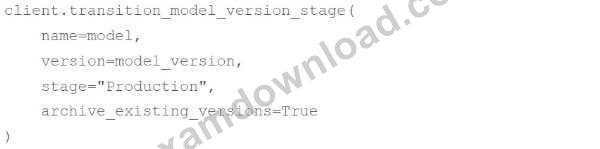
- B.
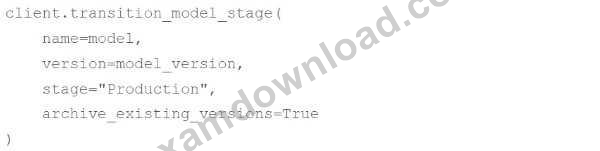
- C.
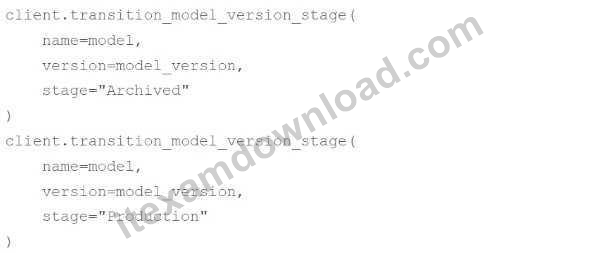
- D.
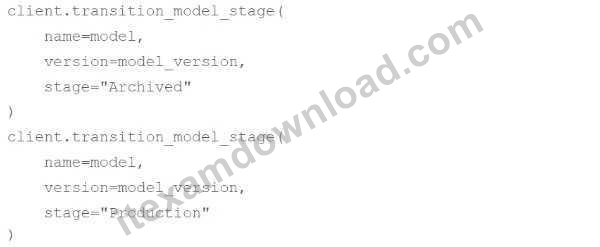
Correct Answer: B 🗳️
A machine learning engineering team has written predictions computed in a batch job to a Delta table for querying. However, the team has noticed that the querying is running slowly. The team has already tuned the size of the data files. Upon investigating, the team has concluded that the rows meeting the query condition are sparsely located throughout each of the data files. Based on the scenario, which optimization technique could speed up the query by colocating similar records while considering values in multiple columns?
- A. Bin-packing
- B. Write as a Parquet file
- C. Z-Ordering
- D. Tuning the file size
- E. Data skipping
Correct Answer: C 🗳️
A team is building a machine learning pipeline, which includes feature engineering, model training, model evaluation, and model deployment. Over the last year, the project has grown a lot, with multiple contributors working on it. Currently, they are manually testing their pipelines and functions. However, they are looking to build out a MLOps process and want to organize their unit tests. Which approach to organizing functions and unit tests should they take?
- A. Organize functions and unit tests together in multiple notebooks, grouping them by feature or component.
- B. Place all functions and their corresponding unit tests in a single notebook or script.
- C. Separate functions into dedicated modules and place all unit tests in a separate test suite or notebook.
- D. Write unit tests only after deployment to avoid slowing down development.
Correct Answer: C 🗳️
Explanation: Only visible for ITExamDownload members. You can sign-up / login (it's free).
A data scientist wants to track the runs of their random forest model. The data scientist is changing the number of trees and the maximum depth of the trees in the forest across each run.
They write the following code block:
Which Python object type does params need to be an instance of?
- A. array
- B. dict
- C. list
- D. PySpark DataFrarne
Correct Answer: B 🗳️
Explanation: Only visible for ITExamDownload members. You can sign-up / login (it's free).
A machine learning engineer and data scientist are working together to convert a batch deployment to an always-on streaming deployment. The machine learning engineer has expressed that rigorous data tests must be put in place as a part of their conversion to account for potential changes in data formats. Which of the following describes why these types of data type tests and checks are particularly important for streaming deployments?
- A. All of these statements
- B. Because the streaming deployment is always on, there is a need to confirm that the deployment can autoscale
- C. None of these statements
- D. Because the streaming deployment is always on, there is no practitioner to debug poor model performance
- E. Because the streaming deployment is always on, all types of data must be handled without producing an error
Correct Answer: E 🗳️
Viewing page 1 out of 39 pages.
Viewing questions 1-5 out of 193 questions.
 Berg
Berg 
 Corey
Corey  Martin
 Hedy
Hedy 
 Brook
Brook  Georgia
  Tracy
Tracy  Omar
Omar  Primo
Primo  Harry
Harry  Milo
Milo  Liz
Liz  Miriam
  Jason
Jason  Venus
Venus  Stanford


