

Fortinet NSE4_FGT_AD-7.6 Dumps Questions [2026] Pass for NSE4_FGT_AD-7.6 Exam
Updated Fortinet Study Guide NSE4_FGT_AD-7.6 Dumps Questions
NEW QUESTION # 55
Refer to the exhibits.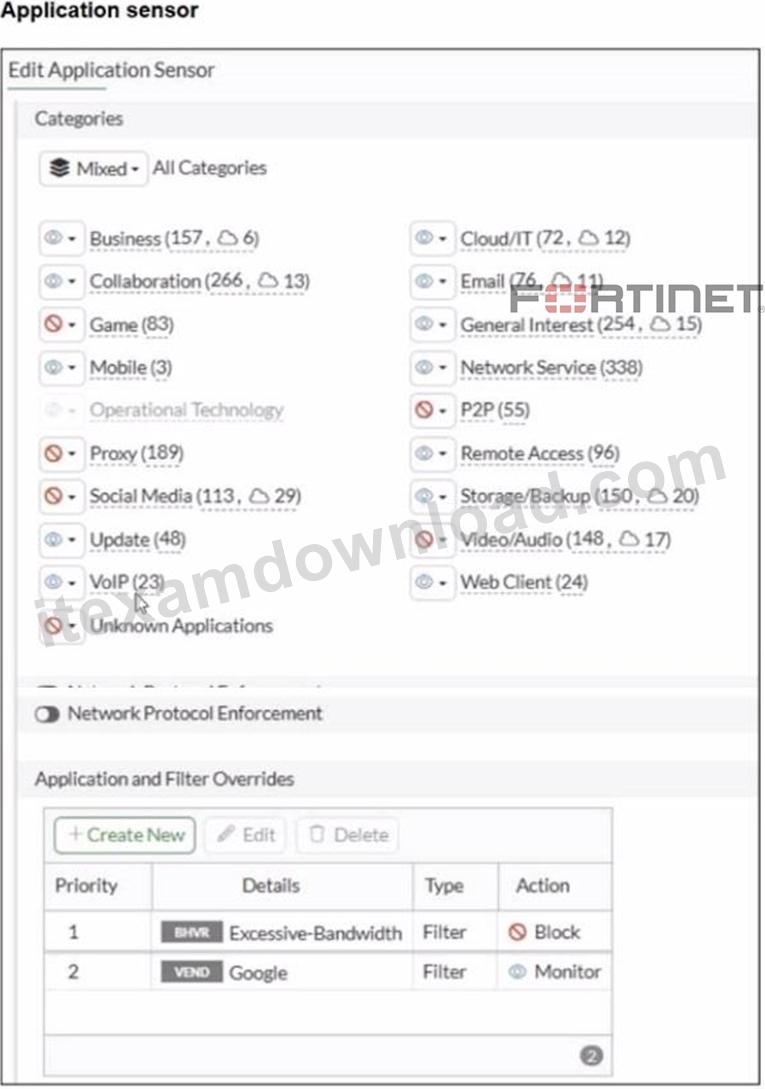
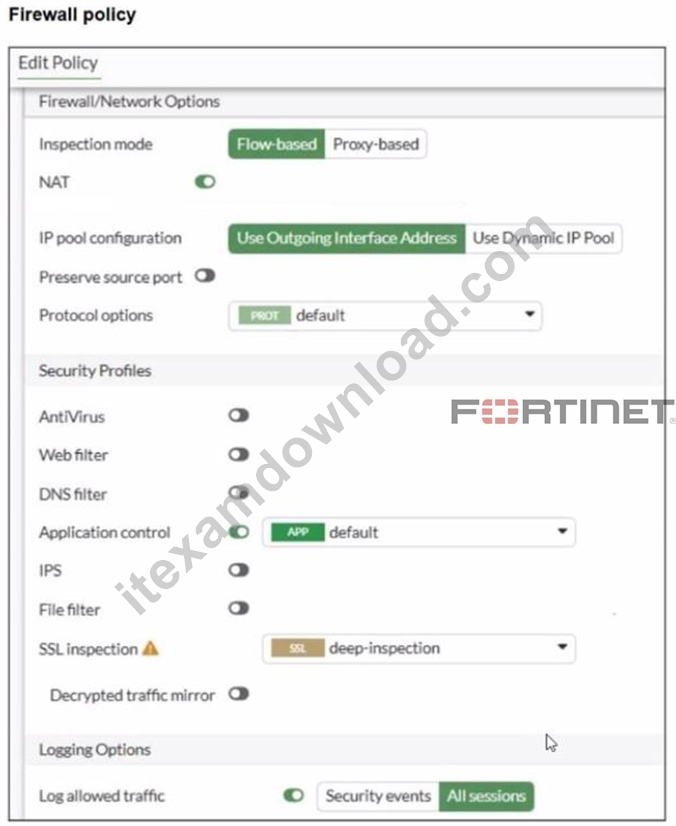
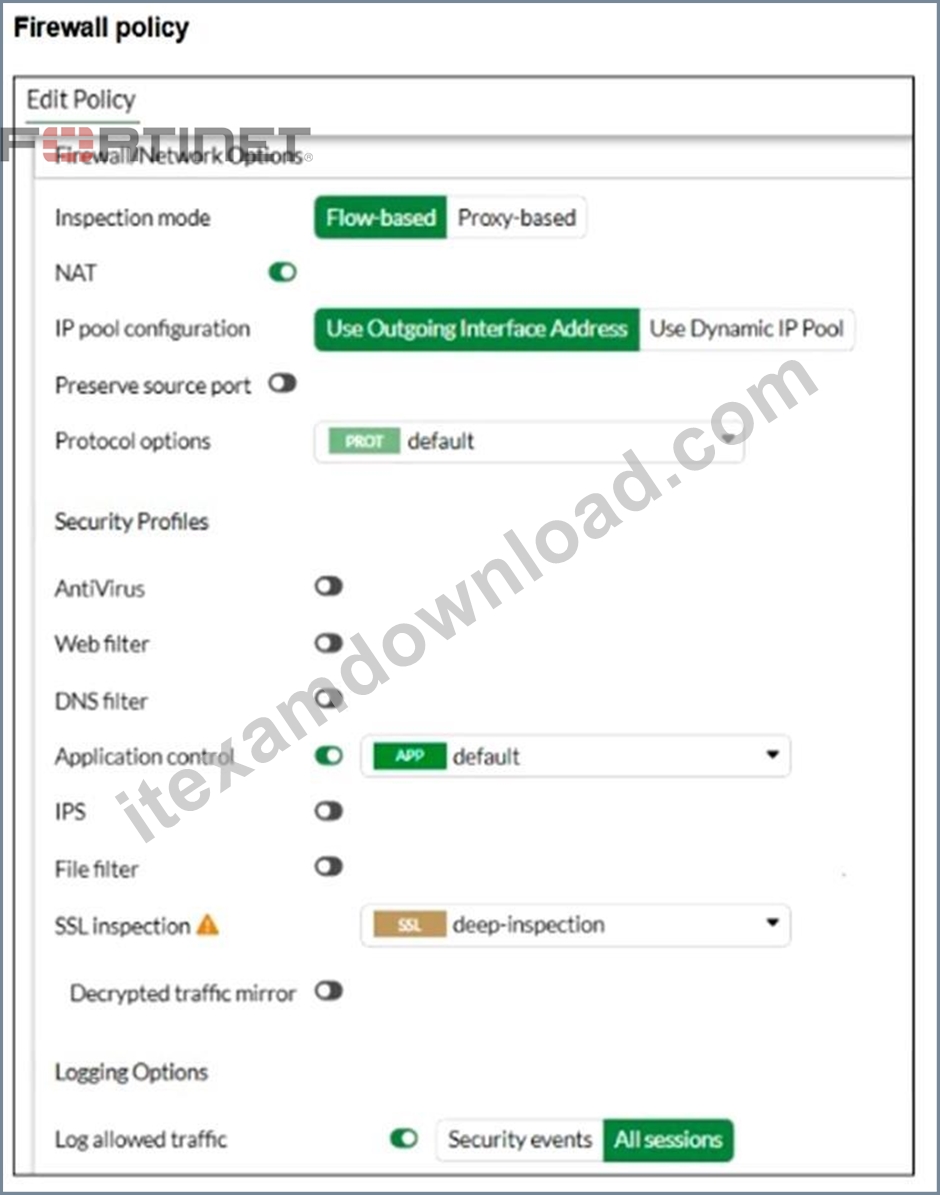
You have implemented the application sensor and the corresponding firewall policy as shown in the exhibits.
Which two factors can you observe from these configurations? (Choose two.)
- A. YouTube access is blocked based on Excessive-Bandwidth Application and Filter override settings.
- B. Facebook access is allowed but you cannot play Facebook videos based on Video/Audio category filter settings.
- C. YouTube search is allowed based on the Google Application and Filter override settings.
- D. Facebook access is blocked based on the category filter settings.
Answer: A,D
Explanation:
From the exhibits:
The Application Control sensor has these key settings:
Application and Filter Overrides
Priority 1: Excessive-Bandwidth (Type: Filter) with Action Block
Priority 2: Google (Type: Filter) with Action Monitor
Category actions shown include Social Media set to Block (this category includes Facebook).
The firewall policy is using:
Flow-based inspection
Application control enabled (profile: default)
Deep inspection enabled (helps identify applications inside HTTPS)
Logging enabled
FortiOS applies Application Control as follows (top-down within the Application Control profile):
Overrides are evaluated by priority (highest priority first).
The first matching override determines the action (block/monitor/allow) for that traffic.
Category-based actions apply to applications that fall into those categories unless an override matches first.
Why A is correct
A). YouTube access is blocked based on Excessive-Bandwidth Application and Filter override settings.
The profile explicitly blocks the Excessive-Bandwidth behavior filter at the highest override priority.
When YouTube traffic is detected as matching the Excessive-Bandwidth behavior, FortiGate will apply the Block action due to the override.
Because this is a priority override, it is enforced before lower-priority entries.
Why B is correct
B). Facebook access is blocked based on the category filter settings.
The Application Sensor shows Social Media configured with a Block action.
Facebook is categorized under Social Media, so it will be blocked when matched by Application Control.
Why C is not correct
C). Facebook access is allowed but you cannot play Facebook videos...
Since the Social Media category is set to Block, Facebook would be blocked at the category level (not merely video playback).
Why D is not correct
D). YouTube search is allowed based on the Google override...
The Google override action is Monitor, not Allow.
"Monitor" logs/detects but does not override a block condition to "allow" traffic.
Also, YouTube traffic is not guaranteed to be treated as "Google" in a way that would permit it, and any matching block condition (such as Excessive-Bandwidth) would still take precedence.
NEW QUESTION # 56
What are three key routing principles in SD-WAN? (Choose three.)
- A. By default. SD-WAN rules are skipped if the included SD-WAN members do not have a valid route to the destination.
- B. By default. SD-WAN rules are skipped if only one route to the destination is available.
- C. By default. SD-WAN rules are skipped if the best route to the destination is not an SD-WAN member.
- D. Regular policy routes have precedence over SD-WAN rules.
- E. SD-WAN rules have precedence over any other type of routes.
Answer: A,C,D
Explanation:
SD-WAN rules are matched only if the best route to the destination points to SD-WAN SD-WAN member is selected only if it has a route to the destination
https://docs.fortinet.com/document/fortigate/7.0.0/sd-wan-sd-branch-architecture-for- mssps/768108/sd-wan-routing-logic SDWAN rules are 'policy routes', but regular policy routes have precedence over SD-WAN rules.
https://community.fortinet.com/t5/FortiGate/Technical-Tip-Explaining-the-SD-WAN-rule-matching- process/ta-p/284325
NEW QUESTION # 57
Refer to the exhibits.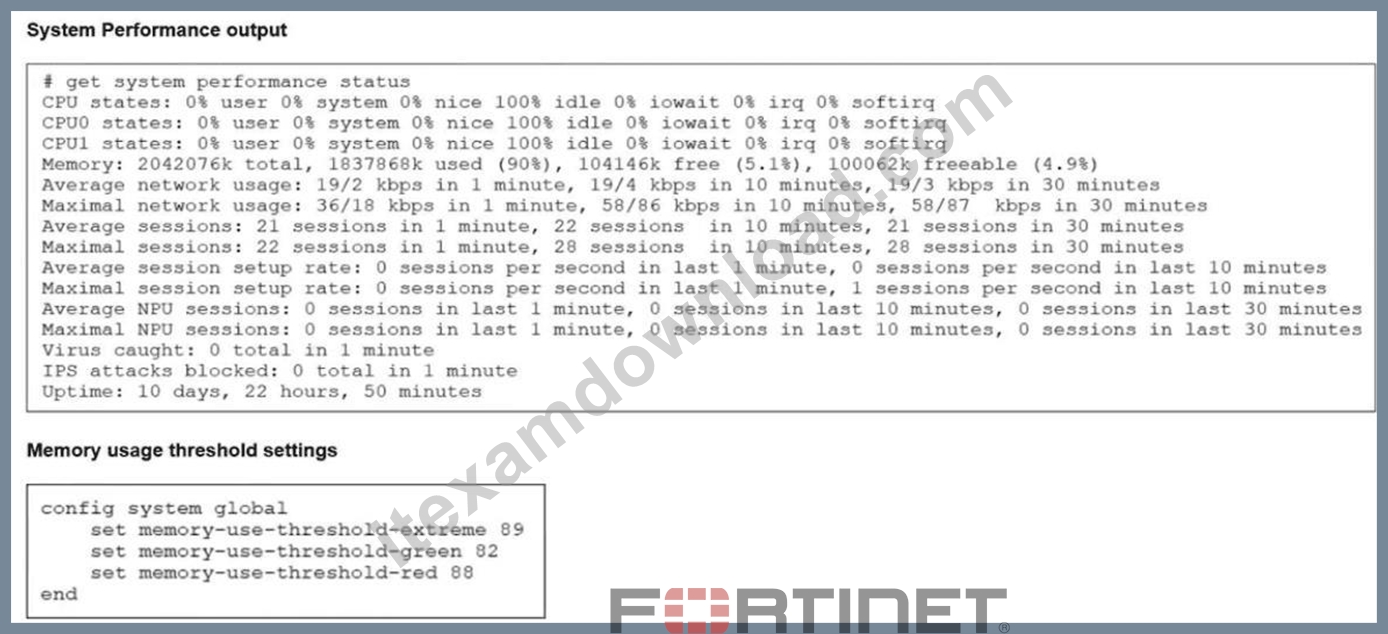
The system performance output and default configuration of high memory usage thresholds on a FortiGate device are shown.
Based on the system performance output, what are the two possible outcomes? (Choose two.)
- A. Administrators can access FortiGate only through the console port.
- B. FortiGate drops new sessions.
- C. Administrators can change the configuration.
- D. FortiGate has entered conserve mode.
Answer: C,D
Explanation:
From the exhibits:
System performance output
Memory used: 90%
Free memory: ~5%
Default memory thresholds (FortiOS 7.6)
memory-use-threshold-green 82%
memory-use-threshold-red 88%
memory-use-threshold-extreme 89%
Because memory usage (90%) exceeds the extreme threshold (89%), the FortiGate enters conserve mode.
Effects of conserve mode (FortiOS 7.6 - verified)
B). FortiGate has entered conserve mode.
Correct
When memory usage exceeds the red/extreme threshold, FortiGate automatically enters conserve mode.
This is exactly the condition shown in the system performance output.
D). Administrators can change the configuration.
Correct
Even in conserve mode:
Administrators can still log in (GUI, SSH, console)
Configuration changes are allowed
FortiGate does not lock configuration access during conserve mode.
This behavior is explicitly documented in the FortiOS 7.6 Conserve Mode section.
Why the other options are incorrect
A). Administrators can access FortiGate only through the console port.
Incorrect
Network access (GUI/SSH) is still available in conserve mode unless otherwise restricted.
Console-only access is not a conserve-mode requirement.
C). FortiGate drops new sessions.
Incorrect (as a general statement)
FortiGate may drop or bypass new inspection-required sessions depending on fail-open/fail-close settings.
It does not universally drop all new sessions, so this statement is not always true.
NEW QUESTION # 58
Refer to the exhibit.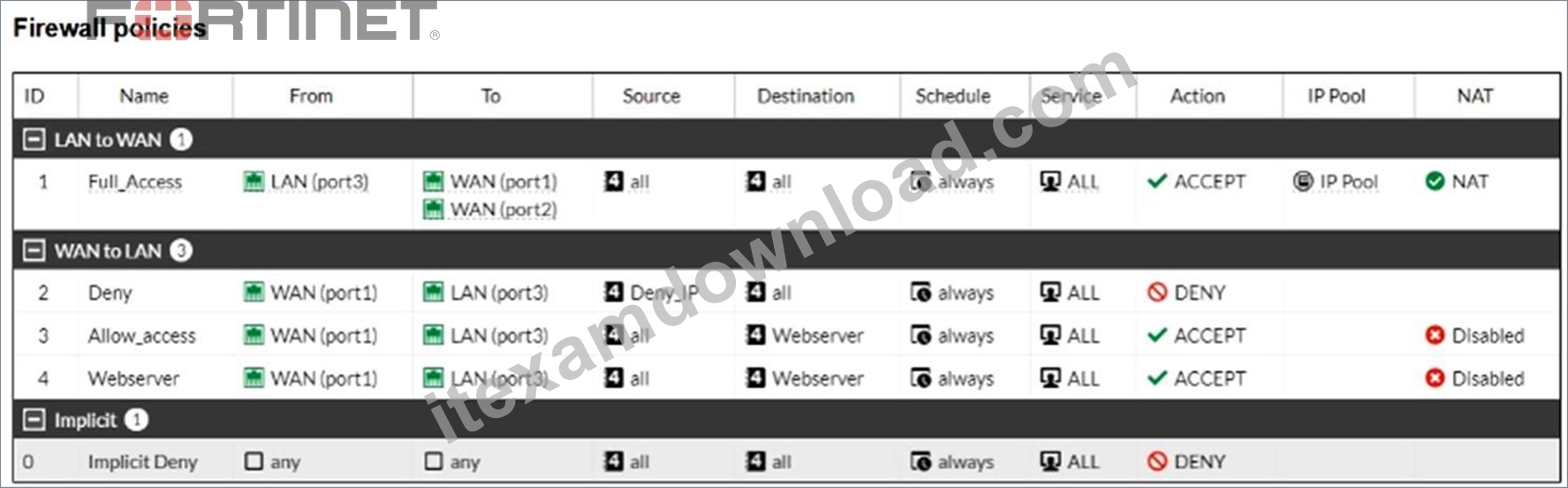
Which statement about this firewall policy list is true?
- A. The firewall policies are listed by ingress and egress interfaces pairing view.
- B. The Implicit group can include more than one deny firewall policy.
- C. The firewall policies are listed by ID sequence view.
- D. LAN to WAN, WAN to LAN, and Implicit are sequence grouping view lists.
Answer: D
Explanation:
The firewall policy list shown is displayed in the sequence grouping view, where policies are grouped based on their traffic direction - such as LAN to WAN, WAN to LAN, and Implicit. This view helps administrators quickly identify and manage policies according to their interface pairings and logical traffic flow, rather than by numerical ID order.
NEW QUESTION # 59
Refer to the exhibit, which shows an SD-WAN zone configuration on the FortiGate GUI.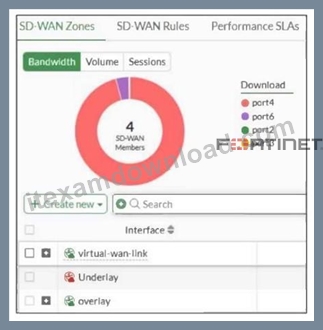
Based on the exhibit, which statement is true?
- A. The virtual-wan-link and overlay zones can be deleted.
- B. port2 and port3 are not assigned to a zone.
- C. The Underlay zone is the zone by default.
- D. The Underlay zone contains no member.
Answer: D
Explanation:
Underlay is not a default zone. It is user defined and not active.
NEW QUESTION # 60
Refer to the exhibits.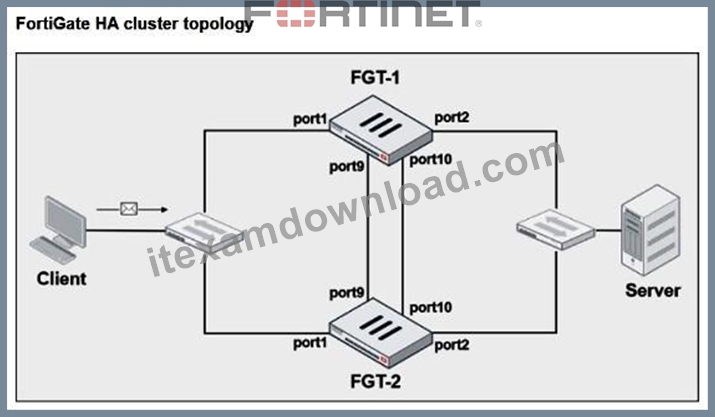
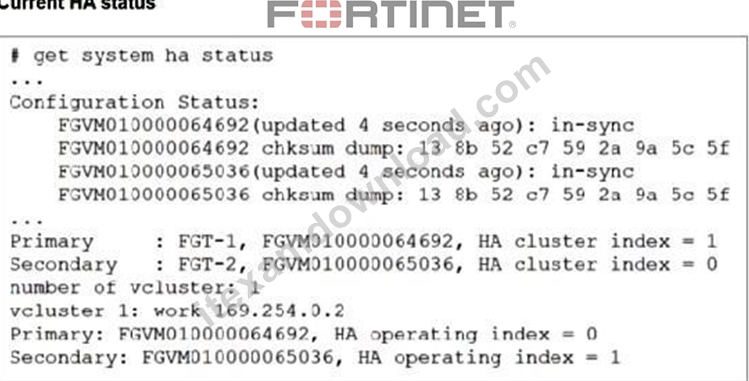
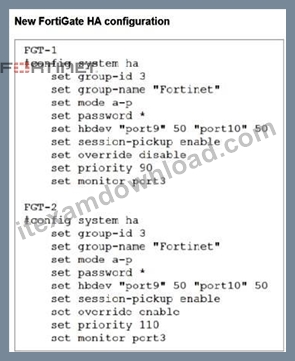
FGT-1 and FGT-2 are updated with HA configuration commands shown in the exhibit.
What would be the expected outcome in the HA cluster?
- A. The HA cluster will become out of sync because the overridesetting must match on all HA members.
- B. FGT-2 will take over as the primary because it has the override enablesetting and higher priority than FGT-1.
- C. FGT-1 will synchronize the override disablesetting with FGT-2.
- D. FGT-1 will remain the primary because FGT-2 has lower priority.
Answer: B
Explanation:
With override enabled, the primary unit with the highest device priority will always become the primary unit. Whenever an event occurs that may affect primary unit selection, the cluster negotiates. For example, when override is enabled a cluster renegotiates when you change the device priority of any cluster unit or when you add a new unit to a cluster.
Override and primary unit selection
Enabling override changes the order of primary unit selection. As shown below, if override is enabled, primary unit selection considers device priority before age and serial number. This means that if you set the device priority higher on one cluster unit, with override enabled this cluster unit becomes the primary unit even if its age and serial number are lower than other cluster units..
NEW QUESTION # 61
Refer to the exhibit.
A partial cloud topology is shown.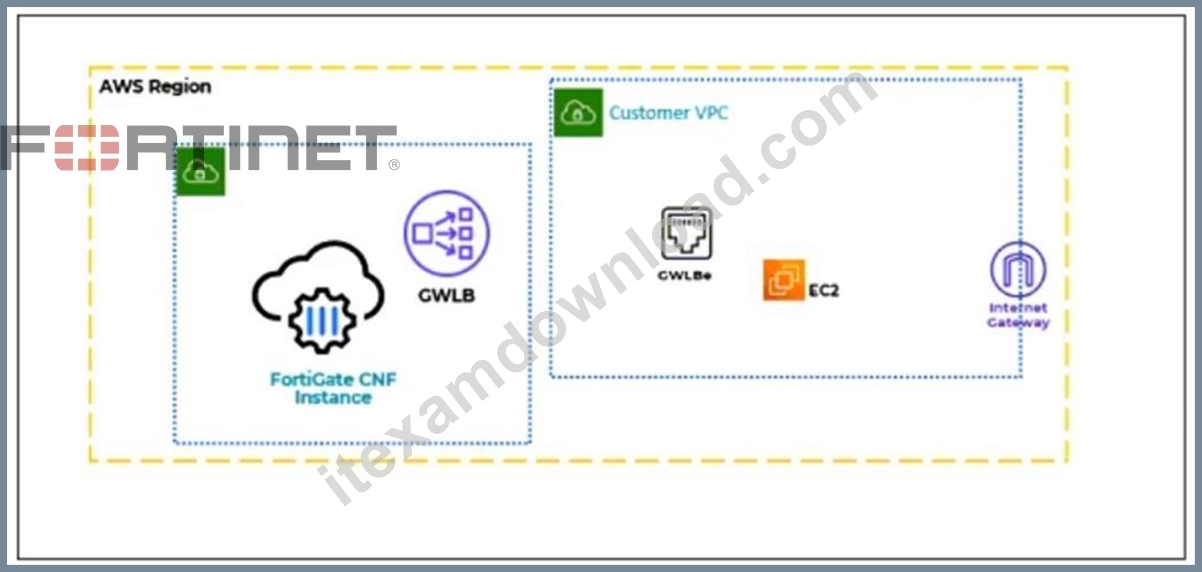
You deployed a FortiGate Cloud-Native Firewall (CNF) in AWS.
During the deployment, which components must be FortiGate CNF create to handle traffic from the EC2 instance?
- A. The CNF VPC, customer VPC, and GWLB
- B. The gateway load balancer endpoint (GWLBe) in the customer virtual private cloud (VPC)
- C. The customer VPC and GWLBe
- D. The GWLB, GWLBe, and the internet gateway (IGW) in the customer VPC
Answer: B
Explanation:
The FortiGate CNF must create the gateway load balancer endpoint (GWLBe) in the customer VPC to handle traffic redirection from EC2 instances to the FortiGate CNF via the gateway load balancer (GWLB).
NEW QUESTION # 62
You have created a web filter profile named restrictmedia-profile with a daily category usage quota.
When you are adding the profile to the firewall policy, the restrict_media-profile is not listed in the available web profile drop down.
What could be the reason?
- A. The web filter profile is already referenced in another firewall policy.
- B. The firewall policy is in no-inspection mode instead of deep-inspection.
- C. The naming convention used in the web filter profile is restricting it in the firewall policy.
- D. The inspection mode in the firewall policy is not matching with web filter profile feature set.
Answer: D
Explanation:
In FortiOS 7.6, web filter profiles are inspection-mode dependent. Certain advanced web filtering features- such as daily category usage quota-are only supported when the firewall policy is operating in proxy-based inspection mode.
Why the profile is not visible
The profile restrictmedia-profile includes a daily category usage quota.
Daily quotas are a proxy-based web filtering feature.
If the firewall policy is configured with:
Inspection mode: Flow-based
Then FortiGate will not display proxy-only web filter profiles in the Web Filter drop-down list.
FortiGate automatically filters the available profiles based on feature compatibility with the policy's inspection mode.
This behavior is explicitly documented in the FortiOS 7.6 Web Filtering and Inspection Mode Compatibility sections.
Why the other options are incorrect
A). Already referenced in another firewall policyWeb filter profiles can be reused across multiple policies.
This does not hide them.
B). Firewall policy is in no-inspection mode instead of deep-inspectionSSL inspection depth affects HTTPS visibility, not whether a web filter profile appears in the drop-down list.
C). Naming convention restrictionFortiOS does not restrict profile selection based on naming conventions.
NEW QUESTION # 63
What is the primary FortiGate election process when the HA override setting is enabled? (Choose one answer)
- A. Connected monitored ports > Priority > System uptime > FortiGate serial number
- B. Connected monitored ports > Priority > HA uptime > FortiGate serial number
- C. Connected monitored ports > System uptime > Priority > FortiGate serial number
- D. Connected monitored ports > HA uptime > Priority > FortiGate serial number
Answer: B
Explanation:
According to the FortiOS 7.6 Study Guide and technical documentation regarding High Availability (HA), the FortiGate Clustering Protocol (FGCP) uses a specific set of rules to elect the primary unit in a cluster. By default, the election order follows: Connected Monitored Ports > HA Uptime > Priority > Serial Number.
However, when the HA override setting is enabled, the election logic is modified to prioritize the administrator-defined priority value over the uptime of the cluster members. In this specific configuration, the election process follows this sequence:
* Connected monitored ports: The unit with the most functioning monitored interfaces is preferred.
* Priority: The unit with the highest manually configured priority value (e.g., 255) is selected next.
* HA uptime: If monitored ports and priority are equal, the unit that has been up in the HA cluster the longest is chosen.
* FortiGate serial number: As a final tie-breaker, the unit with the higher serial number is elected.1 Statement A is correct because it reflects the shift where Priority is evaluated immediately after monitored ports, overriding the standard uptime advantage. Statements B and D are incorrect because the FGCP uses HA uptime, not system uptime, for its calculations.
NEW QUESTION # 64
The FortiGate device HQ-NGFW-1 with the IP address 10.0.13.254 sends logs to the FortiAnalyzer device with the IP address 10.0.13.125. The administrator wants to verify that reliable logging is enabled on HQ-NGFW-1.
Which exhibit helps with the verification?
- A.
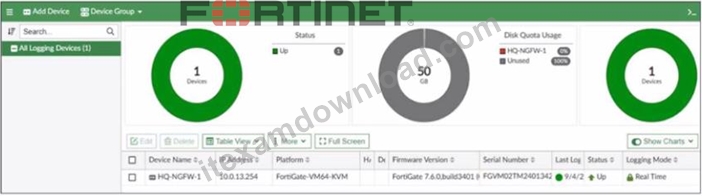
- B.
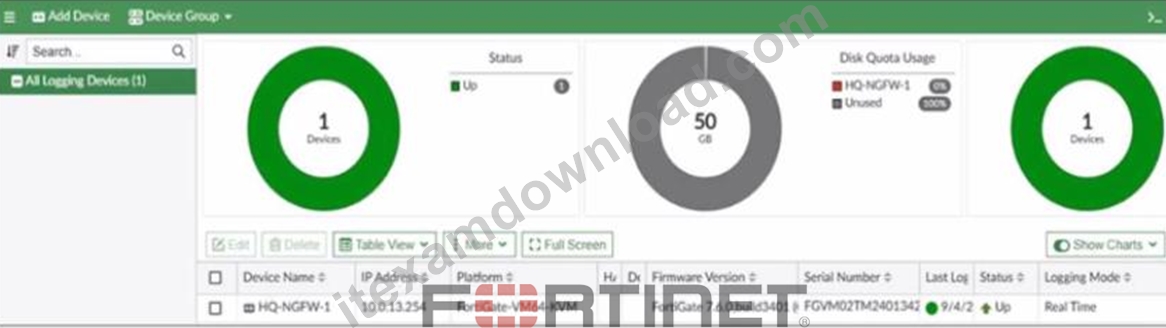
- C.
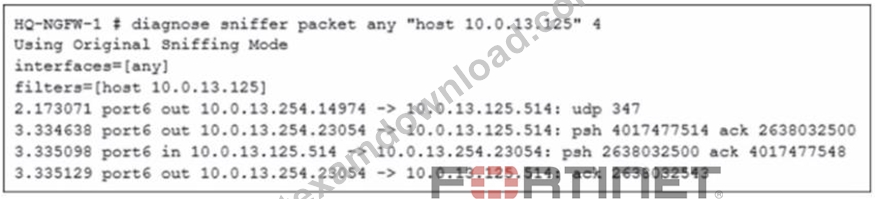
- D.
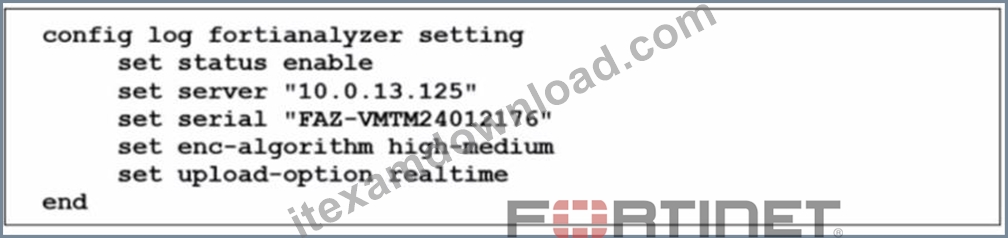
Answer: D
NEW QUESTION # 65
Refer to the exhibit. Review the intrusion prevention system (IPS) profile signature settings shown in the exhibit. What can you conclude about the signature when adding the FTP.Login.Failed signature to the IPS Sensor profile?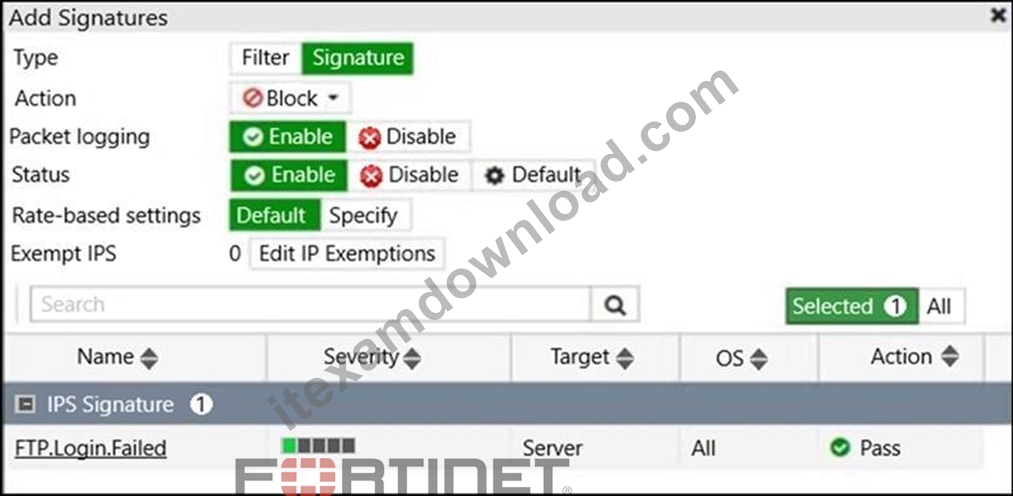
- A. The signature setting uses a custom rating threshold
- B. FortiGate allows this low severity signature packet and creates a log.
- C. The signature setting includes a group of other signatures.
- D. FortiGate stores a local copy of the packet that matches the signature.
Answer: D
Explanation:
When you add a signature to an IPS sensor, the sensor's override settings take precedence over the default signature action in the FortiGuard database.
This means:
The IPS profile's action (Block) overrides the base signature's action (Pass).
The signature "FTP.Login.Failed" is still low severity, but because it's enabled and logging is on, FortiGate blocks it and logs the event (including packet data)..
NEW QUESTION # 66
Refer to the exhibit. Which two statements about the FortiGuard connection are true? (Choose two.)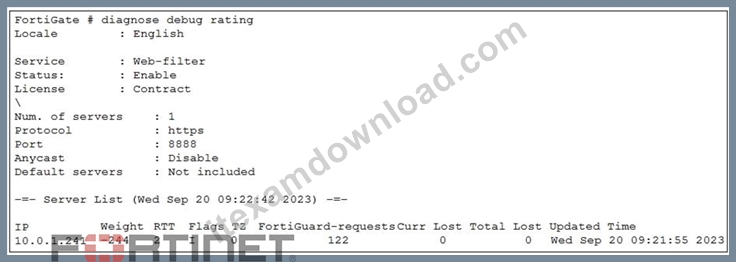
- A. You can configure unreliable protocols to communicate with FortiGuard Server.
- B. The weight increases as the number of failed packets rises.
- C. FortiGate identified the FortiGuard Server using DNS lookup.
- D. FortiGate is using the default port for FortiGuard communication.
Answer: B,D
Explanation:
FortiGuard web filtering, DNS filtering, and antispam service.fortiguard.net uses a proprietary protocol over UDP port 53 or 8888 securewf.fortiguard.net uses HTTPS over ports 443, 53, or
8888.
The weight value reflects server reliability. It decreases with good performance and increases as packet loss or failures rise, meaning higher weight indicates more failures.
NEW QUESTION # 67
What are two features of the NGFW profile-based mode? (Choose two.)
- A. NGFW profile-based mode supports applying applications and web filtering profiles in a firewall policy.
- B. NGFW profile-based mode must require the use of central source NAT policy.
- C. NGFW profile-based mode can only be applied globally and not on individual VDOMs.
- D. NGFW profile-based mode policies support both flow inspection and proxy inspection.
Answer: A,D
Explanation:
NGFW (Next Generation Firewall) profile-based mode in FortiGate allows policies to use both flow- based and proxy-based inspection modes, providing flexibility depending on security and performance requirements. Additionally, profile-based mode supports applying applications and web filtering profiles directly in a firewall policy, allowing granular control over the traffic.
NEW QUESTION # 68
Refer to the exhibit. In the network shown in the exhibit, the web client cannot connect to the HTTP web server. The administrator runs the FortiGate built-in sniffer and gets the output shown in the exhibit.
What should the administrator do next, to troubleshoot the problem?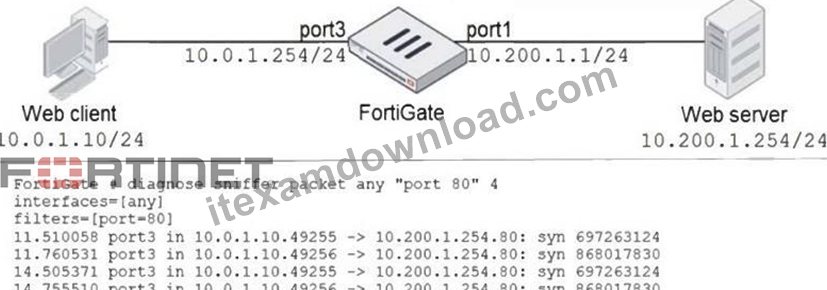
- A. Run a sniffer on the web server.
- B. Capture the traffic using an external sniffer connected to port1.
- C. Execute another sniffer on FortiGate, this time with the filter "host 10.0.1.10".
- D. Execute a debug flow.
Answer: D
Explanation:
If FortiGate is dropping packets, can a packet capture (sniffer) be used to identify the reason? To find the cause, you should use the debug (packet) flow.
NEW QUESTION # 69
Refer to the exhibit.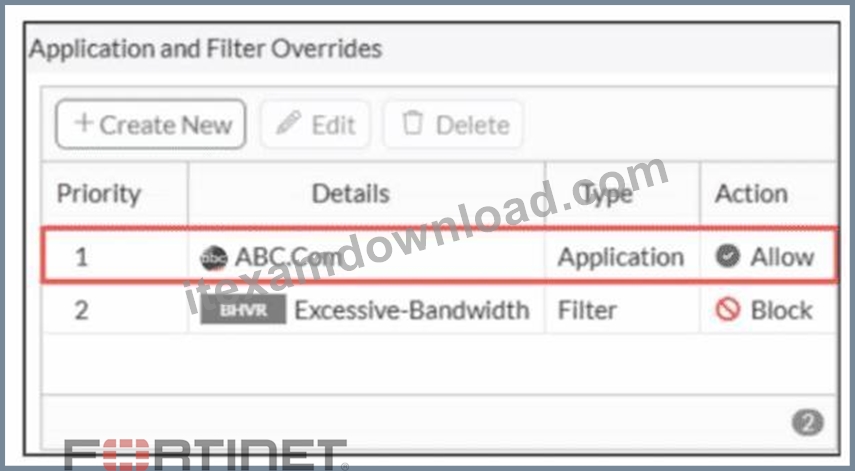
An administrator has configured an Application Overrides for the ABC.Com application signature and set the Action to Allow This application control profile is then applied to a firewall policy that is scanning all outbound traffic. Logging is enabled in the firewall policy. To test the configuration, the administrator accessed the ABC.Com web site several times.
Why are there no logs generated under security logs for ABC.Com?
- A. The ABC Com Action is set to Allow
- B. The ABC Com is hitting the category Excessive-Bandwidth.
- C. The ABC.Com Type is set as Application instead of Filter.
- D. The ABC.Com is configured under application profile, which must be configured as a web filter profile.
Answer: A
Explanation:
In FortiOS 7.6 Application Control, security logs are generated primarily for actions such as Block or Monitor, not for Allow actions.
What is happening in the exhibit
An Application Override is configured for ABC.Com
Type: Application
Action: Allow
The application control profile is applied to a firewall policy
Logging is enabled on the firewall policy
Traffic to ABC.Com is successfully allowed
However, no security logs appear for ABC.Com.
Why no logs are generated
In FortiOS 7.6:
Application Control logs are written to Security Logs when:
An application is Blocked
An application is Monitored
When an application action is set to Allow:
The traffic is permitted silently
No application control security log is generated
Even if policy logging is enabled
This is expected and documented behavior.
To generate logs for allowed applications, the action must be set to Monitor, not Allow.
Why the other options are incorrect
A). ABC.Com is hitting the category Excessive-BandwidthIncorrect. ABC.Com has a higher-priority explicit override (priority 1), so it is not evaluated against the Excessive-Bandwidth filter.
B). The ABC.Com Type is set as Application instead of FilterIncorrect. Application-type overrides are valid and commonly used; this does not suppress logging.
C). The ABC.Com must be configured as a web filter profileIncorrect. This traffic is being evaluated by Application Control, not Web Filter.
NEW QUESTION # 70
Refer to the exhibits.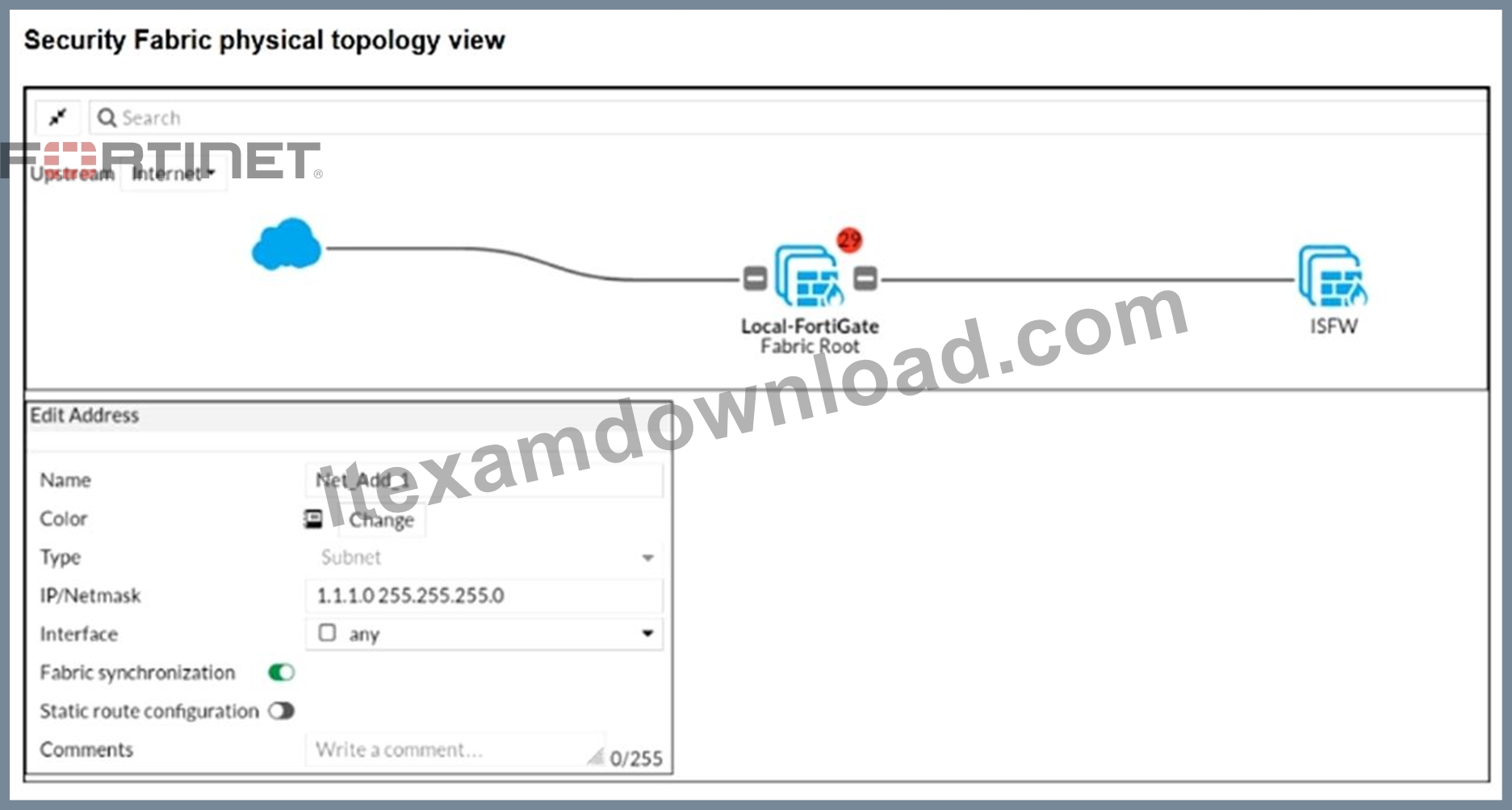
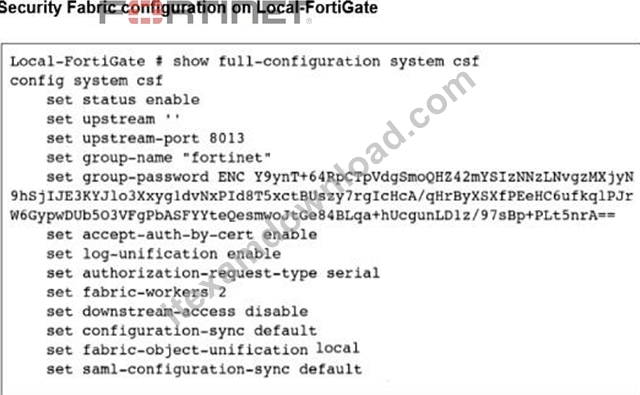
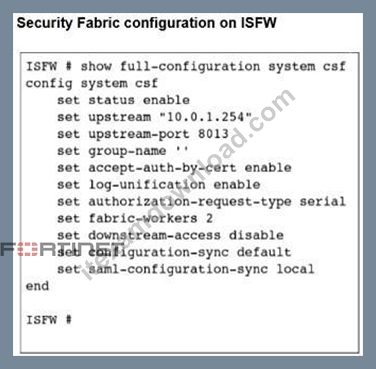
An administrator creates a new address object on the root FortiGate (Local-FortiGate) in the security fabric. After synchronization, this object is not available on the downstream FortiGate (ISFW).
What must the administrator do to synchronize the address object?
- A. Change the csfsetting on Local-FortiGate (root) to set fabric object-unification default.
- B. Change the csfsetting on ISFW (downstream) to set authorization-request-type certificate.
- C. Change the csfsetting on ISFW (downstream) to set configuration-sync local.
- D. Change the csfsetting on both devices to set downstream-access enable.
Answer: A
Explanation:
The CLI command fabric-object-unification is available only on the root FortiGate device. When set to local, global objects are not synchronized to downstream devices in the Security Fabric.
The default value is default.
NEW QUESTION # 71
Which three strategies are valid SD-WAN rule strategies for member selection? (Choose three.)
- A. Best Quality with load balancing
- B. Lowest Quality (SLA) with load balancing
- C. Manual with load balancing
- D. Lowest Cost (SLA) with load balancing
- E. Lowest Cost (SLA) without load balancing
Answer: A,D,E
Explanation:
Lowest Cost (SLA) without load balancing → This is a valid strategy, selecting the path with the lowest cost that meets SLA requirements.
Lowest Cost (SLA) with load balancing → Also valid; it distributes sessions across the lowest-cost links that satisfy the SLA.
Best Quality with load balancing → Valid; it chooses the best-performing link based on SLA metrics such as latency, jitter, and packet loss, while also distributing sessions.
NEW QUESTION # 72
Refer to the exhibits. You have implemented the application sensor and the corresponding firewall policy as shown in the exhibits.
Which two factors can you observe from these configurations? (Choose two.)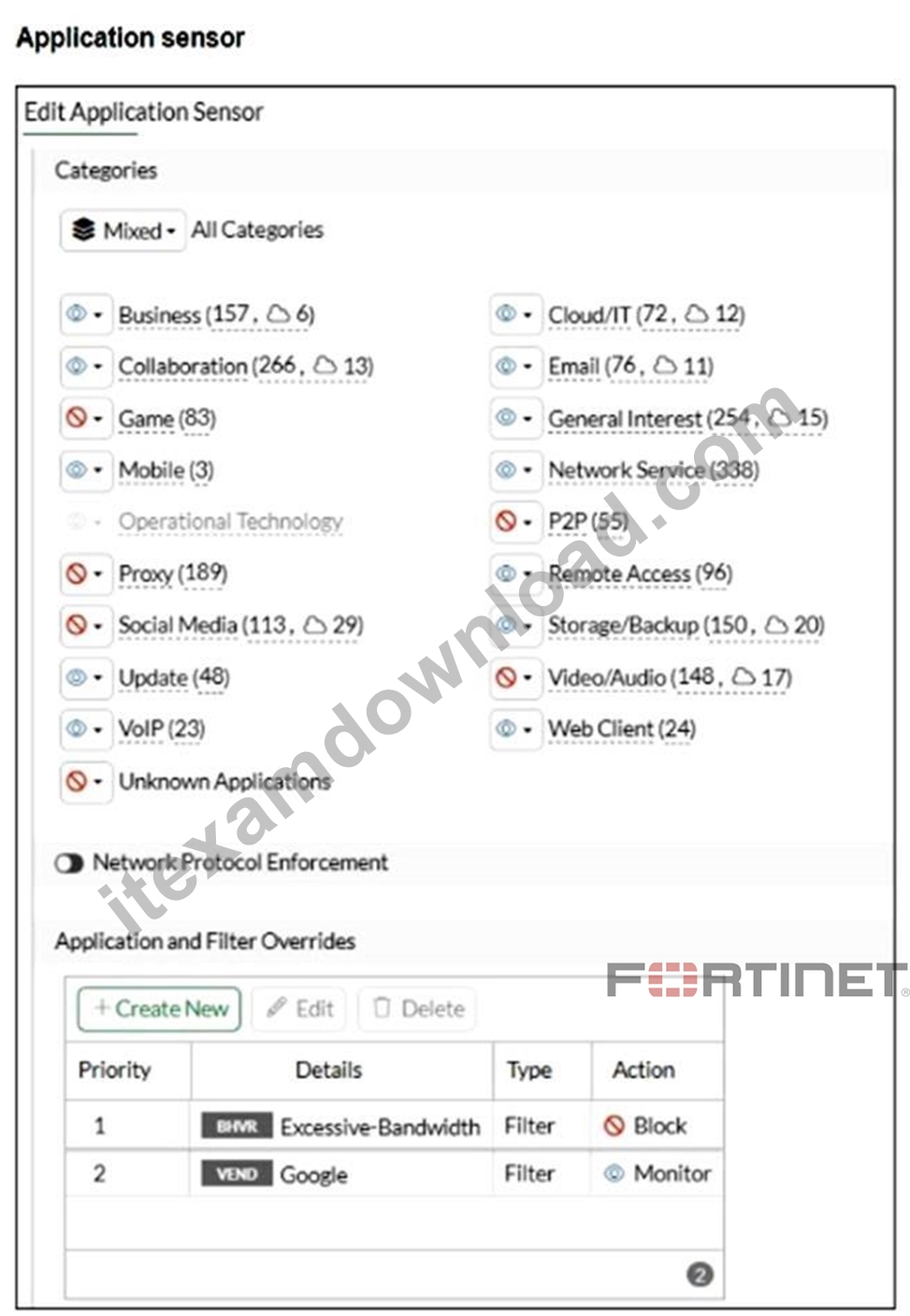
- A. YouTube search is allowed based on the Google Application and Filter override settings.
- B. Facebook access is blocked based on the category filter settings.
- C. YouTube access is blocked based on Excessive-Bandwidth Application and Filter override settings.
- D. Facebook access is allowed but you cannot play Facebook videos based on Video/Audio category filter settings.
Answer: A,D
Explanation:
Facebook belongs to the Social Media application category, which is set to Block in the application sensor. Therefore, any Facebook application traffic is blocked by category.
YouTube Search may fall under Google services or General Interest depending on how traffic is parsed (especially with SSL deep inspection).
The Google application override is set to Monitor, which means traffic is allowed, just logged.
The Video/Audio category (which includes YouTube video playback) is blocked, but this does not block YouTube Search, which is just browsing and searching on the site, is not blocked by the Video/Audio category unless the actual video stream starts.
NEW QUESTION # 73
Which three statements explain a flow-based antivirus profile? (Choose three.)
- A. If a virus is detected, the last packet is delivered to the client.
- B. Flow-based inspection uses a hybrid of the scanning modes available in proxy-based inspection.
- C. FortiGate buffers the whole file but transmits to the client at the same time.
- D. The IPS engine handles the process as a standalone.
- E. Flow-based inspection optimizes performance compared to proxy-based inspection.
Answer: B,C,E
Explanation:
Flow-based antivirus buffers the entire file while simultaneously transmitting data to the client to minimize latency.
Flow-based inspection combines multiple scanning techniques from proxy-based modes for efficient detection.
Flow-based inspection provides better performance by processing traffic on the fly without full proxy overhead.
NEW QUESTION # 74
A network administrator enabled antivirus and selected an SSL inspection profile on a firewall policy. When downloading an EICAR test file through HTTP, FortiGate detects the virus and blocks the file. When downloading the same file through HTTPS, FortiGate does not detect the virus and does not block the file, allowing it to be downloaded.
The administrator confirms that the traffic matches the configured firewall policy. What are two reasons for the failed virus detection by FortiGate? (Choose two.)
- A. The browser does not trust the FortiGate self-signed CA certificate.
- B. The website is exempted from SSL inspection.
- C. The El CAR test file exceeds the protocol options oversize limit.
- D. The selected SSL inspection profile has certificate inspection enabled.
Answer: B,D
Explanation:
Certificate inspection is not deep ssl inspection hence no inspection of the packet would happen since it is encrypted.
If the https site is in exampted list then yes it is a valid reason.
NEW QUESTION # 75
......
Fortinet NSE4_FGT_AD-7.6 Exam Syllabus Topics:
| Topic | Details |
|---|---|
| Topic 1 |
|
| Topic 2 |
|
| Topic 3 |
|
| Topic 4 |
|
| Topic 5 |
|
Achieve Success in Actual NSE4_FGT_AD-7.6 Exam NSE4_FGT_AD-7.6 Exam Dumps: https://pass4sure.itexamdownload.com/NSE4_FGT_AD-7.6-valid-questions.html